
Morocco rewards artists because it resists a single visual summary. Atlantic towns, mountain villages, desert edges, cultivated valleys and historic medinas each create different relationships between material, colour and light. The artist’s task is not to collect “Moroccan” motifs, but to look closely at a particular place.
Earth colour begins with material
Walls, paths and buildings often draw colour from local earth, plaster, stone and weather. That creates subtle families of ochre, rose, grey and umber rather than one uniform warm tone. When painting, ask what a surface is made from and how light changes it. A wall in shade may contain cooler reflected colour even when its local colour is warm.
Craft makes structure visible
Zellige, carved plaster, woodwork, weaving, metalwork and ceramics can be studied as systems of repetition, variation and skilled labour. Instead of copying every mark, identify how a pattern is built. Where does it repeat? Where does scale change? Which imperfection reveals the hand of the maker?
Credit and context matter. Avoid presenting traditional craft as anonymous decoration. Museums, makers, guides and reputable cultural sources can help explain what you are seeing.
Architecture frames experience
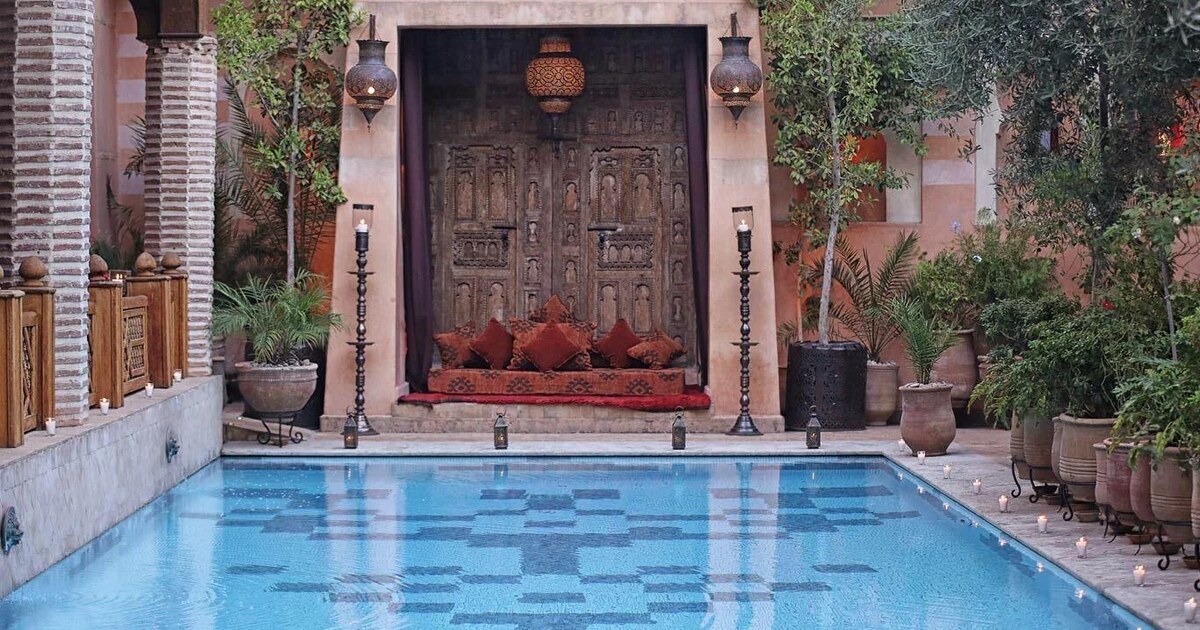
Courtyards, thresholds, covered lanes and interior gardens organise movement between brightness and shade. They also create strong compositions. A doorway may frame several spatial layers; a wall may become a field of reflected colour; a small figure may establish scale within a large form.
Landscape encourages simplification
Mountains and desert-edge landscapes can appear highly detailed, but distance groups them into broad value and temperature changes. Start with the largest silhouette, then separate sunlit and shadow families. Atmospheric depth usually depends more on controlled contrast than on adding individual rocks or buildings.
Markets teach editing
A busy market contains more information than one painting can hold. Choose a visual sentence: perhaps orange fruit beneath a striped awning, stacked pottery against a pale wall or figures moving between deep shade and sunlight. Let the rest support that relationship rather than competing with it.
Respectful observation
Artists remain guests in working and lived spaces. Ask before making a recognisable portrait, follow rules at religious and historic sites, do not block entrances or trade, and accept that some experiences should not become images. Respect improves the work because it replaces hurried extraction with attention.
From national inspiration to a specific study
The phrase “Morocco inspires artists” becomes meaningful only when it leads to specific questions: how reflected light enters one courtyard, how a regional building material changes colour, or how a craft pattern establishes rhythm. That specificity prevents a painting from becoming a collection of travel clichés.
For Marrakech-focused observation, continue with why Marrakech inspires artists and our Morocco colour palette guide. The current Marrakech watercolour retreat places structured tuition within this wider cultural and visual context.