
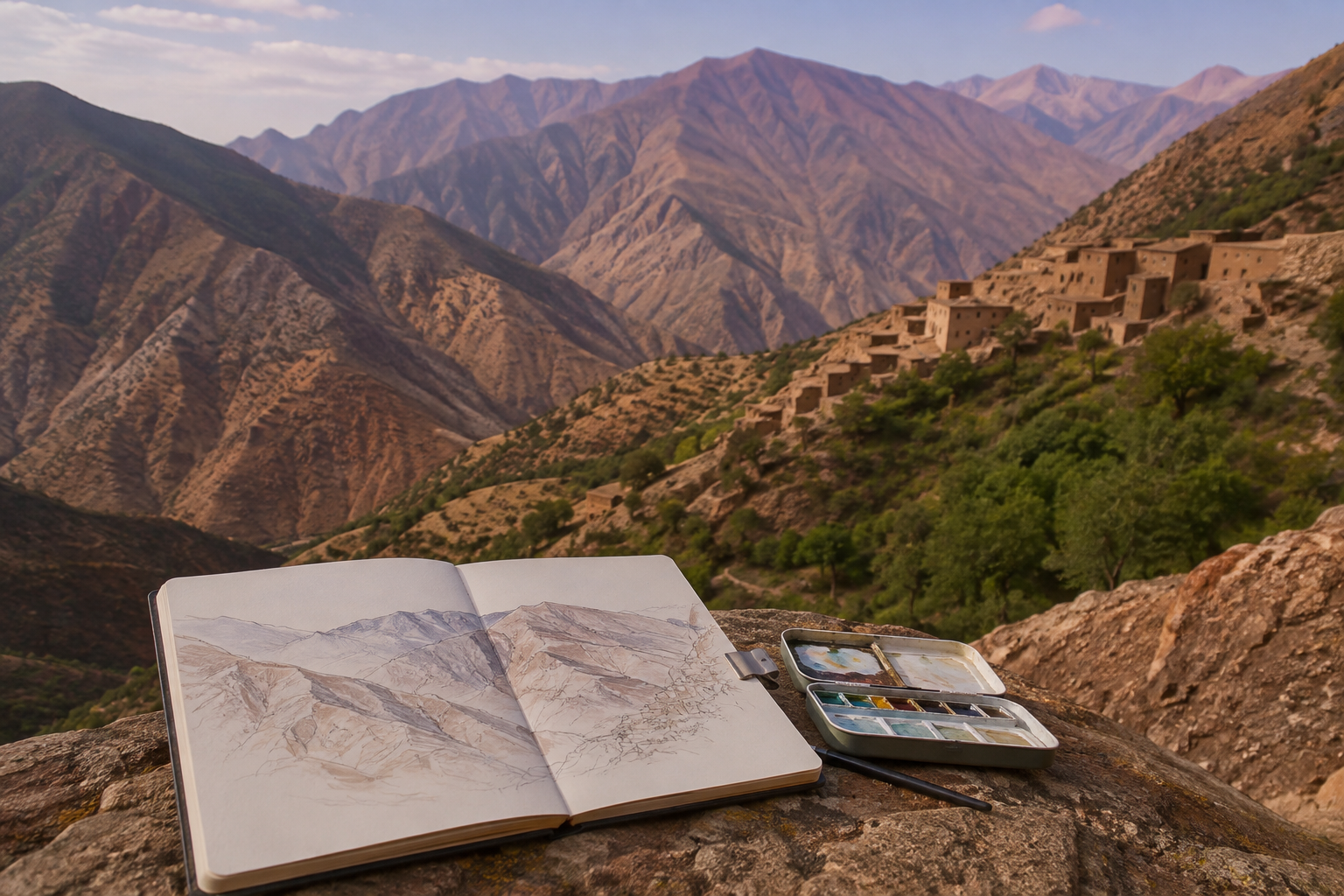
The Atlas Mountains can overwhelm a sketchbook because their scale contains countless ridges, rocks, villages and changes of light. The strongest studies usually begin by removing information.
Find the large silhouette first
Before drawing individual peaks, identify the dominant contour against the sky. Use a continuous line or one flat shape. Then locate the valley or foreground shape that leads the eye into the distance. If those two relationships work, smaller ridges can be added selectively.
Organise distance through value
Separate the view into foreground, middle distance and far distance. The foreground can carry the strongest contrast and texture. Middle-distance forms may be grouped into broader shapes. Far mountains usually need less contrast and detail, although clear dry air can make distant edges appear sharper than expected. Paint what you observe rather than applying a formula automatically.
Use temperature as well as tone
Warm earth in sunlight may shift towards cooler violet, blue-grey or neutral mixtures in shadow and distance. Build all of these from a limited palette so the landscape remains connected. Our Morocco palette guide offers a practical starting point.
Earth-built villages belong to the terrain
Buildings made from local materials often share the mountain’s colour. Establish the landform first, then place selected roof lines, walls and dark openings. Avoid outlining every building. A few verticals and cast shadows can reveal settlement without detaching it from the landscape.
A five-stage mountain study
- Draw the skyline and valley direction.
- Reserve the lightest areas.
- Lay one broad colour family across connected terrain.
- Add the main shadow masses while the structure remains simple.
- Finish with only the details that establish scale or focus.
Show scale carefully
A road, tree line, building or small anonymous figure can help the viewer understand distance. Choose scale cues that genuinely exist rather than adding invented picturesque details. Written notes about height, weather or the time light changed can support a later studio painting.
Working outdoors responsibly
Conditions can change quickly. Follow local and guide advice, carry suitable water and clothing, and do not leave marked routes without appropriate knowledge. Ask before drawing identifiable people or private homes. Do not obstruct paths, vehicles or work, and take all materials and waste away with you.
Sketch first, paint later
A small field study does not need to become a finished watercolour. Record value, temperature, direction and one or two details. Later, combine that information with photographs taken where permitted. The sketch preserves your decisions; the photograph preserves information.
This article is a general creative guide and does not imply that an Atlas excursion is included in a particular retreat. Check the live Marrakech programme for confirmed activities. For travel-sketchbook methods, continue with the Morocco sketchbook guide.